Tuesday, March 5, 2013

Everything comes from the Earth!

Third assignment... For this week I was responsible for listing all of the Earth's resources that I used in an entire 24-hour period. If you really think about it, everything we use comes from the Earth. Our food and drinks come from water, animals, and plants. Our homes and the buildings and structures around us are made of clay or glass, among other things that come directly from the Earth. 

So for this assignment I began recording everything I used that involves the Earth onto my iPhone. I started at 6am on March 4th and ended at 6 am on March 5th. Here is my list divided into 8 sections: 

A) Food and Drink 
Water                                                              Turkey 
Starbucks Grande Vanilla Bean                  Cranberries 
Starbucks Breakfast Sandwich                   Orangeade 
Wheat thins                                                   Carrots  

Honey tea                                                       Potato                          
Fruit Snack                                                     Onions                       

B) Housing and other Buildings
  
Home                  Quiksilver building (work) 
Elliots for Pets 

C) Transportation and Roads 
Car                                Freeway 
Gasoline                       Break fluid 
Road                             Sidewalk 

D) Clothing 
Undergarments          Light Sweater 
Shorts                          Dog Sweatshirt 
Sandals                        Jeans 
Top                               Tanktop 
Hoodie                          T-shirt 
Pajama shorts  

E) School Supplies 

Computer                   Tape 
Paper                           Scissors 
Pen

F) Personal Care Products 
Toilet Paper             Lotion 
Toothpaste               Q-tip 
Soap                          Deodorant 
Razor                        Chapstick 
Toothbrush              Hairbrush         
Facewash                  Hair softening Spray 
Shampoo                   Bristle Hairbrush 
Conditioner              Foundation (makeup) 
Concealer                 Blush 
Eyeliner                    Mascara 
Bronzer                     Blow-dryer 
Straightener             Eye-makeup remover 

G) Leisure Activities 
Walked my dog Milo 

H) Other (not listed in categories A-G)    
Oxygen                      Toilet    
Sheets                        Hair tie      
Bedspread                 Towel 
Blanket                      Purse 
Pillowcase                 Keys 
Pillow                         Ladder 
Cell phone                 Door 
Light                          Door knob 
Fan                            Toilet handle 
Door stop                  Wooden boards 
Hardware (metal)   Dust off 
Recycled Bags          Disinfecting Wipes 
Napkins                    Refrigerator 
Debit Card                Television 
Fish Tank Light       Remote Control 
Couch                        Office Chair 
Coffee Table             Radio 
Blanket                     Giftcard 
Cash                          Hand towel 
Phone Charger         

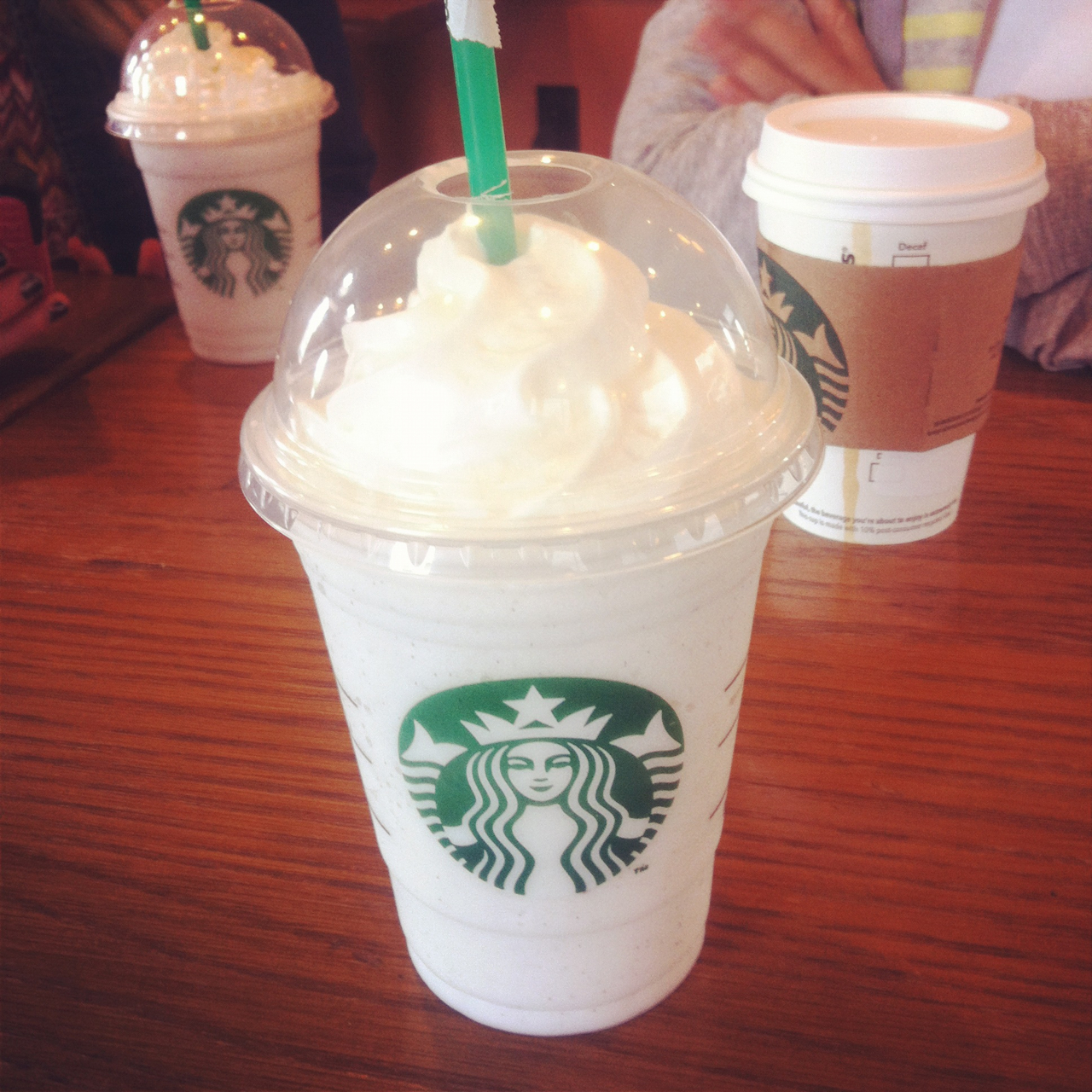
Now that I've compiled my list I must choose 1 of the things on my list to research and answer a few questions about. I chose the Starbucks Grande Vanilla Bean.     


What is it made of?      
Vanilla bean, whole milk, and ice. (And whipped cream on top!).      
 
How is it used?         
It's a popular drink at Starbucks bought purely for flavor and not energy (like coffee) since it has no caffeine!      
   
Where is it distributed, how, and by who?      
These Frappuccino's are distributed at all Starbucks locations and are made by the baristas using a blender.       

What will happen to it when it is no longer "useful"?  
   
Well, I wouldn't say Vanilla Bean Frappuccinos are found "useful" at all, but when they are no longer found desireable they would be taken off of the menu.     

Is the Starbucks Vanilla Bean a "need" or a "want"?
    
I'm sure no one could logically argue that this is anything but a "want".      

What is the effect of this product (production, use, disposal) on:     
Me:                
I spend money, as well take in unneeded calories. And the making of the drink doesn’t seem to effect me now, but with water being wasted constantly washing out the blenders, and the waste building up from cups that cannot be recycled, and all of the energy being used up from the lights… it is and will effect me at some point.

Other People:
The same effects would go for other people as they would for me.

Animals:                 
With so many starbucks locations the production of milk had to have gone up which in turn effects the cows because farmers at Swiss Milk need to get milk out faster.  Also, the cups that are not environmentally friendly effects the environment, in turn effecting animal habitats.

The environment: 
“Starbucks is committed to significantly reducing and diverting the waste our stores generate, and recycling is just one way in which we do this.” - Starbucks.com
     
Unfortunately not all of their cups are environmentally friendly (though in the last few years they come a long way in making their locations more green), and this produces waste that harms the environment. Water is wasted when making the frappuccinos (constantly rinsing the blenders), but the good thing is they are working hard to be more environmentally friendly, check it out for yourself!


http://www.starbucks.com/responsibility/environment

Was the product available 100 years ago? If not, what was used instead?     
This product was not available, in fact Starbucks opened it's first store only 42 years ago. People just drank whatever was popular at that time.      

What alternatives might do more  good or less harm?

Have all cups be environmentally friendly and make reusable cups more cost attractive, use energy efficient everything at every location, open new stores using recycled building materials, and use as little water as possible.


.........
 
At first when I chose to research the Starbucks Vanilla Bean I really did not think I would have answers for a lot of these questions. When I first got to how the making of a Vanilla Bean effects the environment my first thought was “It doesn’t, it’s just blending up a delicious frappuccino!” But when I started to research, I started reading up on just how much operating a Starbucks and making those drinks really does put a footprint on the environment!

So what more can I do, and YOU do to conserve Earth’s resources? 


Obviously we should try to only get things we NEED, not things we WANT. If it’s just something we want at the moment, is it really worth wasting such valuable resources? I would say no. Let’s not waste water, or food. Let’s try to buy things that we know were grown locally. We should also try to recycle and maybe even only purchase from places you know used recycled materials. Starbucks started going green because its environment loving customers stood up and their voices were heard. We need to do this more often so that everywhere is being as environmentally friendly as possible. This Earth provides us with food, shelter, LIFE, and we should return the favor by conserving it every way possible. Join nonprofit organizations, they really do make a difference.

Tuesday, February 26, 2013

Quality Time with Nature

Today I went outside and spent exactly 21 minutes sitting in the grass of my backyard observing all of the abiotic (nonliving) and biotic (living) things around me. Why? Because this is what I had to do to complete my second assignment. And I know my backyard seems pretty boring, but I really was intrigued to see what I could really discover back there!

When I sat down it was exactly 5:23pm and a cold wind was moving everything around me. I created an imaginary sphere around myself (as instructed to do for the assignment) and began observing.


The abiotic things around me that I could see were the following: 
  • Dirt/Soil 
  • 3 redish colored rocks  
  • 1 grey and black bird feather   
  • A ball (Milo's!)
  • Sticks  
  • Power lines 
The biotic things around me were:
  • Lots of grass
  • A few weeds
  • 2 nats
  • 2 nuts
  • 1 baby peach tree

As I continued to sit there I looked up and saw a hummingbird land on a tree branch. This was a simple example of commensalism, which is an interaction that benefits one, but not so much the other. When the hummingbird landed on the tree branch, the tree was giving shelter and protection for the hummingbird, but the hummingbird in return was not giving the tree anything. 
  
However, we usually see hummingbirds having a mutualistic relationship with flowers, meaning both species benefit each other. The flowers give nectar to the hummingbirds, and the hummingbirds unknowingly collect pollen and transfer it to the next flower. This just wasn't the type of interaction I saw unfortunately.  

I watched it carefully and after about 15 seconds, the hummingbird flew off of the tree branch and to my surprise another hummingbird appeared! They twirled around in the air for a few seconds and then flew off together. 


We don't see too many hummingbirds right now compared to in the summer. This is because there are less flowers, meaning less nectar for the hummingbirds to feed on. This is a called a limiting factor. With less food, the number of organisms in a population becomes less. In summer there will no longer be that limiting factor and we should see more!

After this I saw two sparrows fly by, followed by four crows. Though I'm not sure, the crows could have been chasing the sparrows (I've seen this many times before). Crows can actually be carnivorous predators - in other words they feed on mobile prey - and will work together to take down other birds! In this case, the sparrows could have fallen prey to the crows, creating a predator-prey relationship between the two species.

Then an interesting looking bird landed on the powerline above me. It was all black and looked like it had a fluffy head (I really have no idea what it was), but what was most interesting was its chirp. It almost sounded like "chip... chip... chip", very high pitched, and never changed. It flew around my house for the remainder of my quality time with nature, making that same noise, and I never heard any other birds reply with the same chirp. Maybe it was calling for a spring mate?!

At 5:44pm I grabbed my things and my fun with nature had ended. I do very much look forward to doing this again on my own time during a hike and also as the beach! 


You should try it too. Honestly, sitting there quietly and just observing and listening can make even your backyard a very beautiful place. 

Thursday, February 14, 2013

Ecological Footprint

Here's my first assignment! 
So, if everyone lived the way that I do, it would take 5.1 Earths to provide enough resources for everyone to survive. That's insane! 

I really try hard to be environmentally friendly by recycling and buying energy efficient products. However, I do work full time and my job is 20 miles away so I knew that would affect my footprint! The amount of meat and products not grown locally that someone consumes also makes your ecological footprint bigger and I had never even thought about that before! Products not grown locally have to be processed and shipped and that just adds to other parts of the footprint. It's really crazy when you think about it.

According to the Global Footprint Network's website, - I provided the link below so that you can find out your ecological footprint too!- services, things you pay for to get done, accounts for the largest part of my ecological footprint, and goods, tangible items, the smallest.

After getting my results I clicked "explore scenarios" to find out ways to lessen the size of my footprint. The suggestions given to me were to eat half the meat I eat now, purchase more recycled material, use more energy renewable sources such as solar panels, as well as buy only energy-efficient appliances, use public transportation at least once a week, and vacation locally instead of flying. If I were to do all of this my ecological footprint would go down to 4 Earths! It's amazing how much of a difference doing these simple things can make.

Here are some snapshots from the website!


Check it out yourself! http://www.footprintnetwork.org/calculator


A Little About Me

Hi! My name is Samantha Gayton and I have created this blog for my college environmental science class. I am 22 years old and have lived in Southern California my entire life. To start, my favorite color is green, and my favorite number is 27. I have a huge place in my heart for both animals and the environment and in my lifetime, at some point I want to be able to say that I helped save the world. In my spare time I'm always trying to go hiking, biking, swimming down at the beach, or anything else outdoorsy that I can do with my 11 month old puppy Milo! 

I'm not married, and have no kids, but I have been in a relationship with my boyfriend for almost 5 years now. I love to travel! I've been to Louisiana, Texas, Arizona, Illinois (twice!), Georgia, and I am going to Seattle, Washington in April. I'd really, really love to go to Hawaii, Alaska, and Australia one day. The first thing on my bucket list is to see the northern lights in Alaska so that's the place I look forward to the most! As for work, I have worked for Quiksilver Retail since November of 2009 and am now a full time Supervisor. 

Last fall I was set on becoming a Physical Therapist and I took Biology 1 with Huff (also the teacher of this environmental science class) just as a required class. I absolutely fell in love with biology and everything about it. Like I said before I love both animals and the environment, but I guess I never realized how passionate I really was about those things until I took that class. I found myself looking forward to every class, as well as wanting to change my major and can now happily say I am set on becoming an Environmental Scientists and would love to work for the California Department of Fish and Wildlife!

Also, you can check out my Personal Posts, the link is under "Pages". They are environmental/biology based posts so feel free to look at them!